Couples Therapy in Weybridge, Surrey & Online
Couples therapy with Dr Monika Wieliczko, Chartered Clinical Psychologist, for couples experiencing conflict, disconnection, loss of trust or recurring relationship difficulties.

Most couples don't come to therapy because they don't care about their relationship.
They come because they have reached a point where the ways they are trying to fix things are no longer working.
You may keep having versions of the same argument.
One of you wants to talk while the other withdraws. The more one person pushes for connection, the more the other pulls away. Small disagreements quickly become about something much bigger.
Or perhaps you have stopped arguing altogether.
You function well together — managing children, work, family and everyday life — but somewhere along the way you have stopped feeling like a couple.
Sometimes there has been a clear rupture: an affair, betrayal, separation, loss or discovery that has fundamentally changed the relationship.
Couples therapy gives us a place to understand what is happening between you, rather than simply deciding which person is causing the problem.
When Couples Get Stuck

Relationships develop patterns.
Often neither partner consciously creates them.
One person may become increasingly anxious about the relationship and seek reassurance or conversation.
The other experiences this as criticism, pressure or conflict and withdraws.
That withdrawal increases the first person's anxiety, so they pursue harder.
Eventually both people feel misunderstood.
One feels:
“You don't care.”
The other:
“Whatever I do is never enough.”
Both may be trying to protect the relationship while inadvertently creating more distance.
Other couples develop different patterns.
You may:
repeatedly have the same arguments
become defensive very quickly
struggle to repair after conflict
avoid difficult conversations
withdraw or shut down
feel criticised or rejected
experience resentment that has accumulated over time
feel more like co-parents or housemates than partners
struggle with intimacy
disagree about parenting, family or boundaries
feel unable to trust after betrayal
wonder whether you still want the relationship
Couples therapy helps us slow these interactions down and understand what is happening underneath them.
The Argument Is Often About something else
Couples can spend years arguing about money, housework, parenting, sex, phones, work or whose turn it was to do something. But often something else is happening underneath.
Do I matter to you?
Can I depend on you?
Are you going to leave?
Do you see what I carry?
Am I good enough for you?
Is it safe to need you?
When those fears are activated, people protect themselves differently.
Some become angry.
Some pursue.
Some explain.
Some criticise.
Some become extremely rational.
Others disappear emotionally.
Understanding the vulnerability underneath the reaction can begin to change the conversation.
When There Has Been a Rupture or Betrayal
Some couples come to therapy following something that has dramatically changed the relationship.
This may include:
an affair
emotional infidelity
secrecy
repeated dishonesty
addiction or other destructive behaviour
separation
a major breach of trust
traumatic events or loss
discovering something important about your partner that you didn't previously know
After a rupture, couples can become trapped between two different needs.
One partner may desperately need to understand what happened and whether it could happen again.
The other may feel overwhelmed by repeatedly returning to something they cannot undo.
Simply telling a couple to “move forward” rarely resolves this.
Trust usually needs to be rebuilt through understanding what happened, taking responsibility where necessary, making room for the impact of the rupture and gradually establishing whether the relationship can become emotionally safe again.
How Earlier Relationships Can Enter the Relationship You Have Now

We don't enter adult relationships as blank slates.
We bring with us experiences of closeness, dependence, conflict, rejection, affection and repair.
If you learned that conflict leads to abandonment, disagreement with your partner may feel far more threatening than the situation itself suggests.
If depending on other people has historically led to disappointment, withdrawing may feel much safer than needing your partner.
If you grew up taking responsibility for everybody else's emotions, you may continue doing this within your adult relationship until resentment develops.
This doesn't mean that every relationship difficulty is caused by childhood.
It means that two people's histories meet inside a relationship, particularly when both feel hurt or vulnerable.
Understanding this can help couples stop seeing each other simply as the enemy.
Trauma and Relationships
Past trauma can have a significant impact on intimate relationships.
Experiences of abandonment, betrayal, abuse, emotional neglect or unpredictable relationships can shape how we respond to closeness and conflict many years later.
A partner arriving home late, becoming quiet or asking for space may activate something much larger than the immediate situation.
Likewise, intense emotion from a partner may cause somebody else to shut down because emotional conflict has historically felt dangerous.
Part of couples work can involve distinguishing:
What is happening between us now?
from:
What is this situation bringing back for me?
Where one partner has significant trauma-related difficulties, we can also consider whether individual trauma therapy or EMDR may be useful alongside or separately from the couples work.
Read about Trauma & EMDR Therapy →
My Approach to Couples Therapy
I approach couples work from a relational, attachment and trauma-informed perspective.
I am less interested in teaching couples a set of communication rules than in understanding what happens between two people when communication breaks down.
We look at the cycle rather than simply identifying a “difficult” partner.
That means paying attention to:
what triggers the interaction
what each person experiences internally
how each partner protects themselves
what the other person then experiences
how the cycle reinforces itself
what is difficult to say directly
what each person needs from the relationship
The aim isn't to remove disagreement.
Healthy relationships contain disagreement.
The question is whether you can remain connected enough during difficult moments to understand each other, repair what has happened and respond differently.
Does Couples Therapy Mean Staying Together?
No.
I don't begin couples therapy with the assumption that every relationship should be preserved.
Sometimes the work is about repairing a relationship.
Sometimes it is about deciding whether repair is possible.
And occasionally it becomes about understanding how to separate with greater clarity and less destruction.
My role isn't to persuade you to stay together or to decide who is right.
It is to help create the conditions in which both people can understand what has happened to the relationship and make more informed choices about what happens next.
What Happens in the First Couples Therapy Sessions?
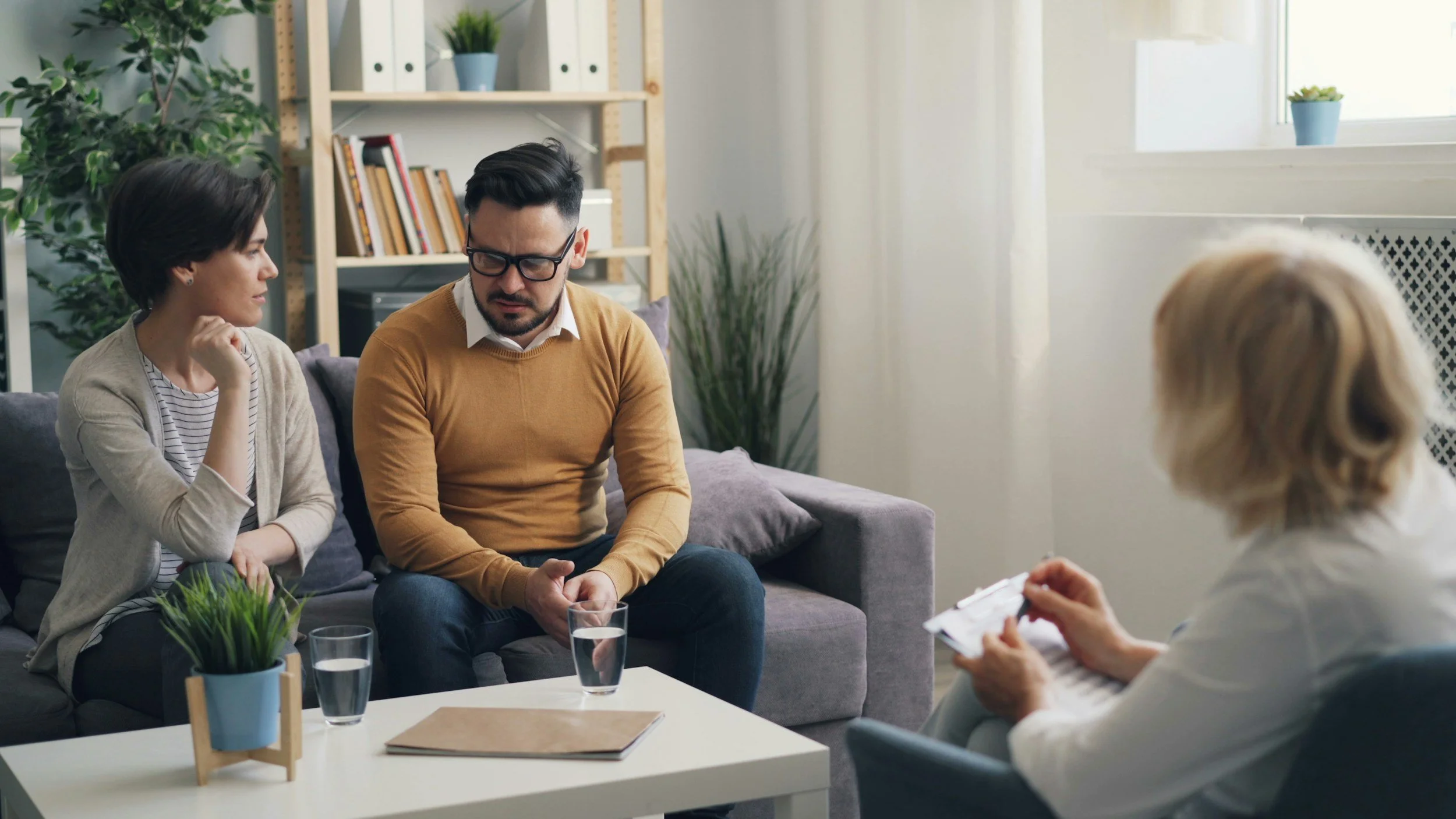
Initially, I want to understand both of you and the relationship you have created together.
We will think about:
what has brought you to therapy now
how the current difficulties developed
what happens when things go wrong
important events in the relationship
each partner's relationship history
what you have already tried
what each of you hopes might change
I am particularly interested in identifying the recurring cycle between you.
Once we understand that cycle, therapy can begin helping you recognise it while it is happening rather than only afterwards.
Couples Therapy in Weybridge, Surrey & Online
I offer couples therapy in Weybridge, Surrey and online.
My Surrey practice works with couples from Weybridge, Cobham, Esher, Walton-on-Thames, Addlestone, Chertsey and surrounding areas.
Online couples therapy is also available where appropriate.
As a Chartered Clinical Psychologist, my approach to relationship difficulties is informed by clinical psychology, relational psychotherapy, attachment theory and trauma psychology.
Clinical Psychologist in Weybridge & Surrey →
Book an Initial Consultation →
Frequently Asked Questions About Couples Therapy
Do we both need to want couples therapy?
It helps if both partners are willing to attend, but you don't necessarily need to agree about what the problem is.
In fact, couples frequently arrive with very different explanations for what has gone wrong.
Part of the work is understanding those different experiences.
Will you tell us who is right?
No.
There may be behaviours that need to be addressed directly and there are circumstances in which responsibility matters.
But couples therapy isn't a court deciding which partner has the stronger case.
I am interested in understanding what happens between you and what each of you contributes to the pattern.
Can couples therapy help after an affair?
It can.
An affair or other significant betrayal can fundamentally disrupt trust and emotional safety.
Therapy can provide a structured place to understand what happened, process its impact and consider whether trust can be rebuilt.
That does not mean returning the relationship to how it was before. The work involves creating a different relationship rather than trying to recreate the old one.
What if we're considering separation?
You can still come to couples therapy.
You don't need to have decided whether you want to stay together before starting.
Therapy can sometimes help couples understand whether repair is possible and, if it isn't, think more clearly about what separation might involve.
Do you work with trauma within couples therapy?
Yes. My background includes trauma and relational trauma, and I pay particular attention to how previous experiences may become activated within intimate relationships.
Where significant trauma requires individual treatment, we can discuss whether separate trauma-focused therapy or EMDR would be appropriate.
Do you offer online couples therapy?
Yes. Couples therapy can be offered online where this is appropriate for the couple and the work.
Starting Couples Therapy
If your relationship has become stuck, you don't need to have decided exactly what you want from therapy before contacting me.
The first step is understanding what has happened between you and what each of you hopes might be different.
Book an Initial Consultation →
Dr Monika Wieliczko
Chartered Clinical Psychologist
Couples · Relationships · Attachment · Trauma
Weybridge, Surrey & Online